

Kant, Cant, Can’t

How did this guy get in your head? Most people today don’t know who he is, and very few have ever read his works. Yet his ideas are embedded in western society, many simply taken for granted as facts of life.
Immanuel Kant impacts your home, work-life, religion, and politics to some degree or other. There are logical explanations for the way people act today, and all the selfishness, anger, and broken relationships have philosophical roots.
Shocked by the scepticism of the Scottish philosopher, David Hume, which undermined the validity of both science and religion, Kant set out to restore a sound basis for morality. He consigned God to the periphery, to place the human individual at the centre of reality. He came to believe that we are free because we are self-ruling beings, bound only by laws that are somehow of our own making. We are “ends in ourselves” and must treat all others as such.
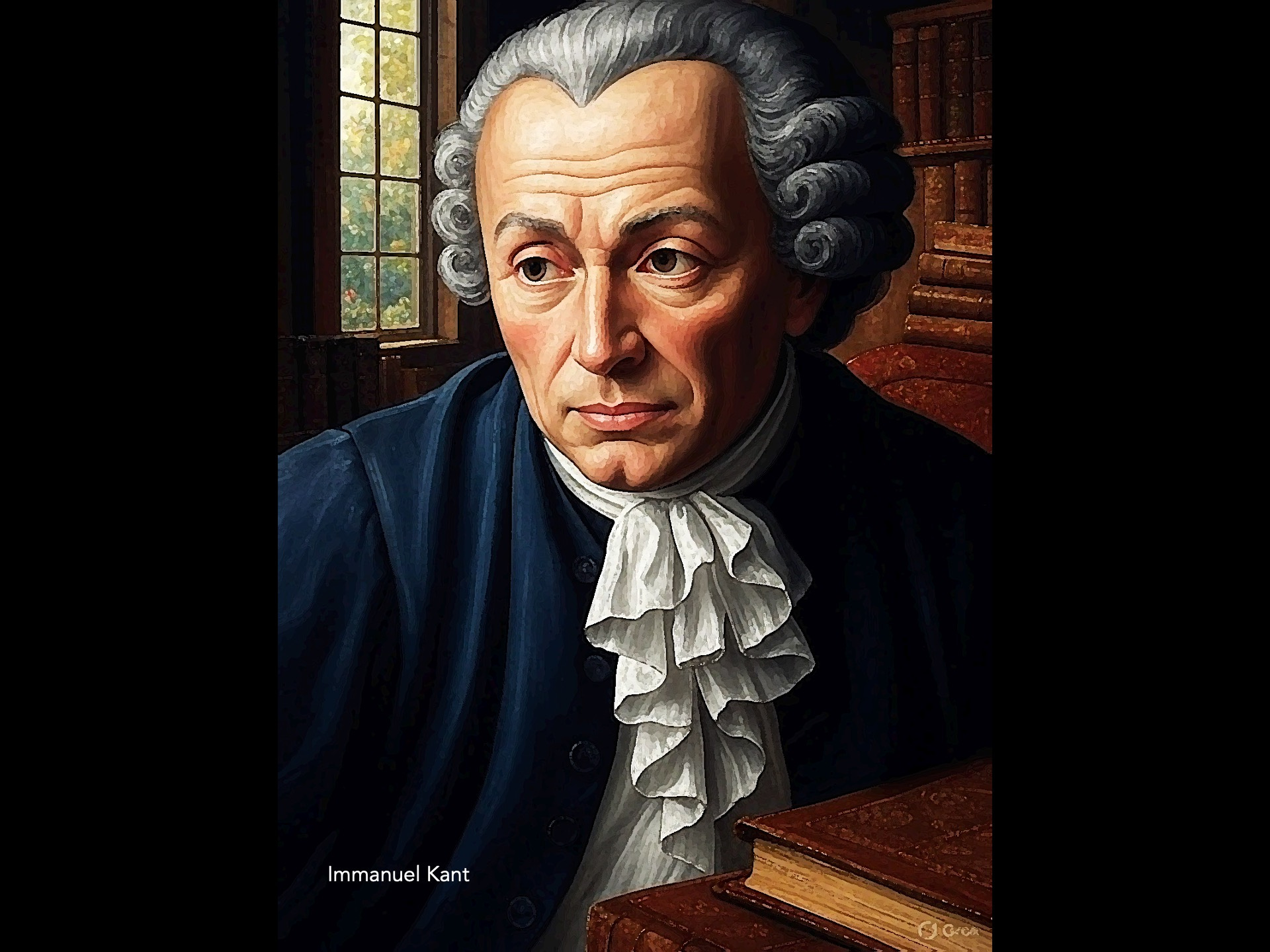
This is why modern people of all stripes embrace “human rights” without specifying where they come from, “human dignity” with no explanation of its source, and “respect for persons” irrespective of the evil things they may do (one thinks of slavery, genocide, racism, crime, etc.).
How can we put modern philosophy in a nutshell? Academics would be horrified, but most ordinary people who know nothing about Descartes, Hobbes, Locke, Hume, Kant, and all the others, are still interested to know how these philosophers shape the way we think today. Knowing why we think the way we do helps us think more accurately, and to better understand ourselves, others, and the world.
So here goes. Classical philosophy saw human beings as born into families, communities, and traditions, with the family as the basic unit of society. Descartes, the first modern philosopher, believed that we can only find the truth about reality by using the power of reason, starting from a first indisputable fact, our own existence.
Hence his famous, cogito ergo sum, “I think, therefore I am”, which gave rise to the detached, autonomous individual replacing the family as the basic unit of society. This helps explain the vast numbers of egocentric people in western society today, the pandemic of narcissism, and the failure of relationships at every level.
Of course, take away our obligations to family and community, and we face serious challenges. Thomas Hobbes maintained the state of nature for human beings was one of unrestricted freedom to do whatever they wanted. John Locke modified this by saying that individuals have the right of self-ownership with extensive freedom to do what they like with the fruits of their labour.
Hobbes paved the way for the radical left-wing liberalism, while Locke provided the model for right-wing libertarianism. Both were liberal in the sense that they built on Descartes’ detached autonomous individual. But the liberal vision still needed a more inspiring reason to win the hearts of ordinary people.
Kant supplied this inspiration with his theory of human dignity, replacing the worship of God with the elevation of self. But the removal of God entailed the loss of morality, and Kant had to explain why we are still obliged to act as moral agents. His answer lay in the autonomy of the human person.
Kant saw human beings as self-governing inasmuch as they are free to choose to do what their reason judges ought to be done. To be moral is to do what your reason tells you is right, instead of being driven by emotions like desire or fear, which would be at odds with your autonomy as a rational being.
Kant still had to explain what our rational minds demand of us in terms of morality. The first stipulation of his famous Categorical Imperative says we should only act according to rules that could be taken as universal laws. This attempt to make human beings self-legislators simply cannot succeed because though people have rational minds, they also have widely differing starting points, their first principles, and seldom have a meeting of minds.
The second stipulation of the Categorical Imperative says we must always treat other human beings as ends in themselves and not as the means to someone else’s ends. Yet as we have seen, the freedom and dignity of human beings based solely on some mythical autonomy we putatively possess because of our rational minds is not grounded in any substantive first principle, such as the Biblical concept of Imago Dei.
The understanding of human beings as made in the image of God, that is, gifted with rational minds and free will has been painstakingly corroborated by many of the great philosophers from various civilisations over thousands of years. Kant dismissed all this exceptional scholarship and embraced a purely procedural reason not grounded in substantive first principles, without which the process of reasoning can and does go all over the show.
The moral confusion of the western world today is proof of Kant’s failure to create a new ethics, and many of his moral musings, such as his puritanical attitude to sex, merely echo the narrow-minded religious tradition from which he arose. His still widespread influence is a clarion call to end the cant and restore the study of philosophy and history in our schools.