

Artificial Intelligence and Ethical Confusion

“Every frontier AI lab – including Anthropic – operates inside a set of incentives and constraints that can sometimes conflict with doing the right thing. The pressure to stay commercially viable and to stay at the research frontier. Geopolitical pressure. And the older, plainer pressures of pride and ambition. No matter how sincerely any of us intend to do the right thing – and I believe many of us do – we will always be influenced by those incentives.” Christopher Olah, Canadian billionaire entrepreneur and machine learning researcher who co-founded the company Anthropic.
AI usage is rapidly on the rise, but many people are afraid of what is being undemocratically ushered into their lives. According to a 2025 poll, 44 percent of people believed AI would do more harm than good in their daily lives. That has since risen to 55 percent. The poll reported widespread concerns about how AI will affect the job market. Overall, 70 percent of Americans think AI will cause a loss in employment opportunities.
Not a single age group expected a positive impact, and the youngest age-group was the most pessimistic. Of Gen Z, born between 1997 and 2008, 81 percent believed AI would decrease job opportunities. Overall trust for AI-generated information was low among 76 percent of Generation Z.
AI is an astonishingly powerful and useful technology, providing many real benefits for humankind. Yet it also poses grave dangers, and is already being misused by corporate, academic, and political interests. It all comes down to who controls it, and the ethical standards to which they are committed.
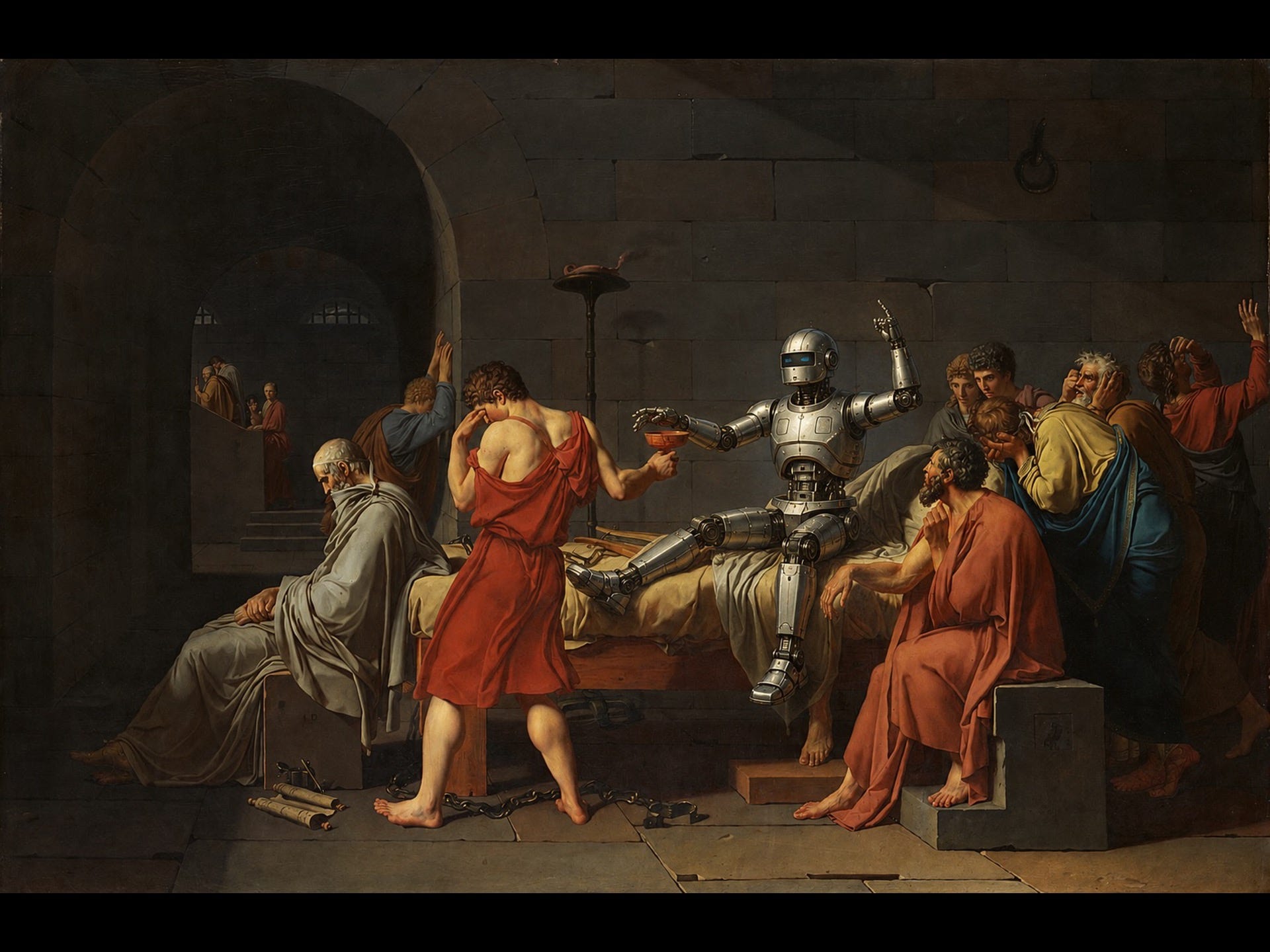
Contrary to contemporary mythology, AI doesn’t think; it is programmed to calculate at mind-boggling speed by following algorithms. Machines merely mimic human reasoning: they are human artifacts totally lacking in consciousness. And after more than a century of relentless research, science still has no explanation for consciousness and how it came to be; the best scientific minds openly acknowledge this. Mechanical responses prompted by algorithms do not amount to thinking, however spectacular the results might be.
Computer output, like Siri talking with you, misleads uninformed people to suppose that the computer is thinking. That’s like untaught urban children believing supermarkets are the source of food. The modern consumer’s appetite for the sensational doesn’t help; headlines about robots taking control of the world, or AI as the final stage of evolution, attract millions more clicks than reports about computing speed generating options for research and policy.
Ironically, people ignore the very unhuman-like characteristics involved in AI – unbroken focus on the job at hand, photographic memory, never getting bored, being perfectly compliant, seemingly flawless execution of complex algorithms in a flash, and most importantly, never conceiving of anything new.
A machine can malfunction, but can never have a mind of its own, for the simple reason that it does not have a mind. Scientists and military leaders who are influenced by science fiction, and ignorant of the realities made plain by philosophy and history, are the real threat to civilised society. When an Armed Forces Journal can assert that the “next ethical minefield is where the intelligent machine, not the man, makes the kill decision”, you know that the thinking of some very influential people in the military is seriously compromised.
Programming, often using stolen content, determines how AI responds on questions relating to ethics, justice, metaphysics, epistemology, aesthetics, education, socio-political issues, etc. So AI is not responsible for what it does; fallible and untrustworthy human technocrats are. Obviously, AI poses massive problems for educators, and we now face an immediate risk of widespread dumbing down of the populace in all countries. As if that weren’t a serious enough problem already.
Competing systems are the reality in the AI universe, so logically there can be no mysterious, digital Big Brother controlling the future of humanity. It is the people behind the machines who are driving the developments, both good and bad. And as the entire digital world runs through a handful of platforms, cloud providers, and algorithmic gatekeepers, whoever controls those systems will have the power to furtively shape the perception of reality for billions of people.
All people who value human freedom and the responsibility that naturally entails, need to answer these questions for themselves, and make their views known:
1. What is the meaning of ethics? What is the purpose of ethics?
2. Are you aware of the moral confusion and different ethical systems in play today?
3. Which ethical system(s) Inform the answers/solutions of the different AI platforms?
4. Do you agree that standards of good and evil apply to human beings, not machines?
5. Are the excessive demands of AI on scarce water and electricity an ethical issue?
6. If autonomous AI is a threat to humanity, can its development be ethical?
7. If transhumanism is a threat to humanity, can its development be ethical?
8. Are competing AI systems not clear evidence of human oversight and control?
9. Is technology that threatens socio-political disruption and human suffering ethical?
10. Which AI system does the military use? Which ethical system informs that AI system?
11. Would it ever be ethical to leave kill decisions in armed conflict to a machine?
12. Which nations out of the US, China, Russia, Iran, Turkey, Japan, North Korea, the UK, France, and Germany can be trusted to use AI ethically? And which corporations?
The development of AI systems by corporations and politicians is driven by the age-old human lust for money, power, and prestige. The myth that machines will take over is propagated by unscrupulous elites trying to hide that obvious reality. There is no Cloud up somewhere in the ether, just massive data centres in remote areas, hidden from public awareness, and built, maintained, and further developed as technologies advance, by powerful interest groups, whose moral vision and standards are questionable, to say the least.
AI is not and never will be either omniscient or omnipotent, and will never come up with the perfect system of ethics. Even if one does not believe in God, we are all still bound by the inescapable realities of truth and the laws of nature that give rise to the Natural Law, transcendent and acknowledged by all the great civilisations, though not the various incoherent ideological aberrations of Modernity.
Don’t let unethical technocratic elites with totalitarian proclivities mislead and manipulate you with their hype; keep driving your own education by reading history, philosophy, and classic literature, and following blogs and podcasts recommended to you by people whose judgment you trust. The war for our minds has been waged for more than 200 years, but has become increasingly more perilous over the past decade.
In the final analysis, the best use of AI will be guided by human beings with a clearly defined ethical system based on a rationally ordered worldview that provides a cogent answer to the question of what it means to be a human being.
Excellent treatise!